
Reviewed · WALKING TOURS
Private Walking Tour of El Pueblo Viejo in Santa Barbara
Santa Barbara’s oldest streets tell a layered story: Spanish soldiers built an adobe outpost here in 1782, Mexican-era families shaped the town, and later residents rebuilt it as a Spanish-style city after the 1925 earthquake. This private walk with Sullivan Israel makes those layers easy to see, especially when he uses old maps and photographs alongside the buildings in front of you.
I like two things right away. First, the route includes major sights such as the Presidio and Casa de la Guerra, but also quieter places like the Lugo Adobe and El Cuartel. Second, Sullivan brings architecture and social history together, including the difficult treatment of the Chumash. The main consideration is pace: the walk lasts only about one to two hours, so anyone wanting to enter every museum or inspect each site at length will need extra time afterward.
In This Review
- Key points to know before you book
- Why El Pueblo Viejo is the right place to begin
- Starting at the 1782 Presidio
- Adobe homes and the story behind 715 Santa Barbara Street
- The Lugo Adobe and Meridian studios
- 802 Anacapa Street and Santa Barbara’s oldest street line
- Casa de la Guerra and the ceremonial center
- El Paseo’s passageways and the change after 1925
- Ending at El Cuartel, an 18th-century time capsule
- What Sullivan Israel adds to the walk
- Timing, comfort, and practical value
- Who should book this Santa Barbara walk
- Should you book it?
- FAQ
- How long does the Private Walking Tour of El Pueblo Viejo last?
- Where does the tour begin?
- Where does the tour end?
- Who leads the tour?
- Is the tour private?
- What language is offered?
- Is admission included?
- Are parking fees included?
- Can I cancel for a full refund?
- What happens if bad weather cancels the tour?
Key points to know before you book
- See California’s oldest Spanish-era buildings: The tour begins at El Presidio and ends at El Cuartel, an 18th-century structure across the street.
- Sullivan Israel leads the walk: Expect a private English-language tour with room for questions and a presentation supported by old maps and photographs.
- Architecture is a major theme: Adobe construction, Spanish Colonial Revival design, Julia Morgan’s work, and post-earthquake rebuilding all fit into the route.
- The route includes quiet corners: The Lugo Adobe, Meridian studios, courtyards, gardens, and the passageways of El Paseo add variety beyond the main landmarks.
- The history is not polished over: The tour addresses the forced labor and harsh treatment of the Chumash under the mission system.
- Plan for a short, easy city walk: Most stops last five to ten minutes, and the tour returns to its starting point.
Why El Pueblo Viejo is the right place to begin
If you have just arrived in Santa Barbara, this district gives you the clearest sense of how the city took shape. El Pueblo Viejo is not a single preserved monument. It is a compact collection of buildings from different periods, often sitting close enough together that you can compare them from one spot.
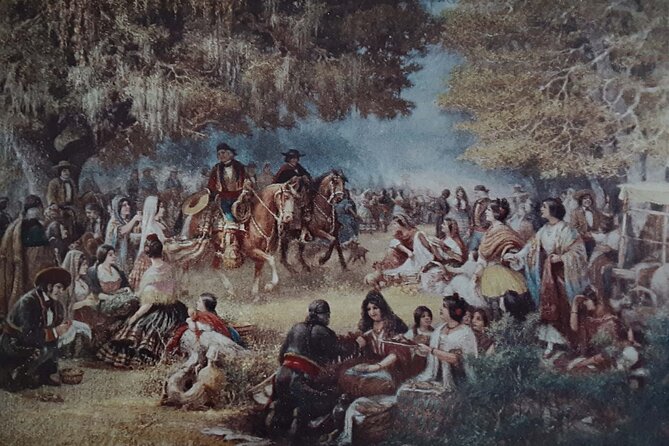
That makes the walk useful. You are not simply hearing dates while moving from one attraction to another. You are watching Santa Barbara change from a Spanish military settlement to a Mexican Californio town, then to an American city, and finally to the Spanish-inspired place seen today.
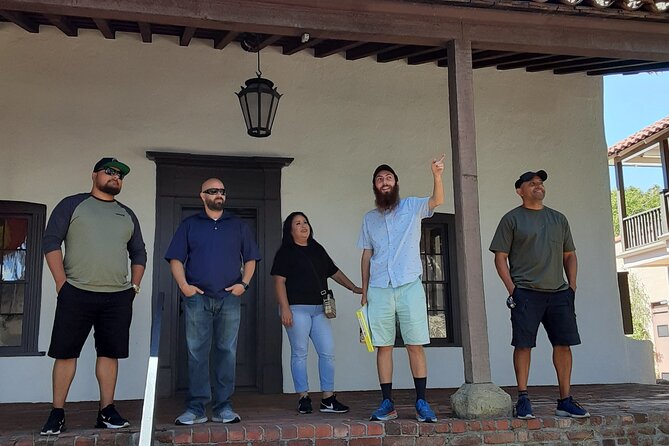
The tour is private, so your group can ask questions without holding up a larger crowd. That matters here because the details are often small: a roof beam, a salvaged adobe brick, an old street line, or a building hidden behind a newer facade. Sullivan’s style, based on the information available about the tour, is conversational and well prepared rather than rushed. He has been praised for bringing historic maps and photographs that show how the same streets looked in earlier periods.
A few more Santa Barbara trips worth weighing up
- The ORIGINAL Downtown Santa Barbara Walking Food & Drink Tour
★ 5.0 · 551 reviews - Private Santa Barbara History and Architecture Walking Tour
★ 5.0 · 56 reviews - Santa Barbara’s Ultimate Wine and Chocolate Walking Tour
★ 5.0 · 19 reviews
Starting at the 1782 Presidio
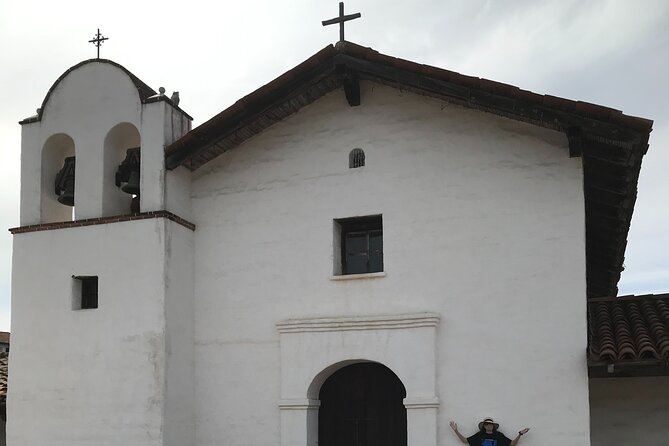
Meet at El Presidio de Santa Bárbara State Historic Park, at 123 East Canon Perdido Street. This is the natural starting point because the Presidio was the military center around which the early settlement grew.
Built in 1782 from adobe brick, it is one of California’s oldest structures. The park includes original rooms, soldiers’ gardens, a chapel, and reconstructions of everyday objects from the 18th century. You can see how the builders relied on materials from the surrounding countryside, a practical reminder that this was a distant outpost of the Spanish Empire, not a developed colonial city.
The official stop here is about ten minutes, with admission included. That is enough for an introduction and a look at the main features, but not enough for a long independent visit to every room. If the Presidio is your main interest, plan to return after the walk.
One useful detail Sullivan may point out is the construction itself. Early Santa Barbara had few trees outside creek beds, and local live oaks twisted in ways that made them poor choices for straight roof beams. Later adobe buildings used pine brought down from the Los Padres mountains, with Chumash people forced to collect and transport it. Details like this connect architecture to labor, geography, and power.
That wider context is one of the strongest reasons to take this walk. Adobe can look picturesque when photographed in the sun. Its construction also reflects who controlled the land and who was made to work on it.
Adobe homes and the story behind 715 Santa Barbara Street
The next section brings you close to the private and political life of early Santa Barbara. At 715 Santa Barbara Street, preserved adobes built in 1817 form part of the Historical Museum.
Domingo Carillo built the structures for his bride, Conception Pico, sister of Pio Pico, who became governor of Alta California. The courtyard gives the group a place to pause in the shade, with a fountain providing a pleasant break from the pavement.
This stop lasts about seven minutes and admission is free. The short visit works well as a storytelling pause. Sullivan can use the buildings to explain Spanish-era families, local power, and tales of pirates and battles connected to the coast.
You may also choose to enter the museum during the walk. Its exhibits cover local history and include paintings and etchings. The courtyard contains two adobe structures dating from 1817 and offers a good photo setting, but remember that a one to two hour private walk cannot give you a full museum visit and a detailed neighborhood tour at the same time.
Nearby, you pass the Rochin Adobe. It was built in 1856 by a descendant of Captain Francisco Ortega, the first commander of the Presidio, using adobe bricks salvaged from the nearly ruined fort. Around 1900, the building received wooden clapboard siding, which it still has today.
That small fact explains much about Santa Barbara. Buildings were altered, covered, reused, and adapted as the town changed. The old city is not frozen in one perfect Spanish moment. It is a place where several periods remain visible at once.
The Lugo Adobe and Meridian studios
The walk then moves toward the Lugo Adobe and Meridian studios, a pleasant contrast to the larger public sites. The Meridian studios were designed by George Washington Smith and completed in 1925. Their pastel stucco walls and broad glass windows reflect the design language that became closely linked with Santa Barbara.
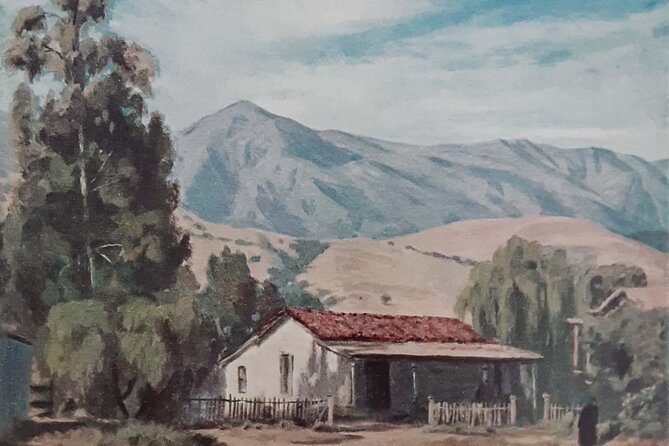
A wisteria vine adds another visual detail. It is covered with purple flowers in spring, although the season will determine what you see. Behind the studios sits the Lugo Adobe, built by a retired Presidio soldier in the early 19th century and later remodeled.
This is a good section for anyone who likes architecture but does not want a tour limited to famous facades. The route shows how Spanish-inspired design was revived and reshaped in the 20th century. You also get a look at how an older adobe can survive beside newer buildings.
Because the Lugo Adobe is in a secluded location, the setting feels quieter than the main plaza areas. That does not mean you should expect a long interior visit. The value here comes from Sullivan’s explanation and from learning to notice the relationship between the buildings.
More days around Santa Barbara:
- Santa Barbara Trolley Tour
★ 4.5 · 787 reviews - Santa Barbara Electric Bike Tour
★ 5.0 · 557 reviews - Kayak Tour of Santa Barbara with Experienced Guide
★ 5.0 · 431 reviews - Spooky Solvang Ghost Hunting & History Tour
★ 5.0 · 310 reviews
802 Anacapa Street and Santa Barbara’s oldest street line
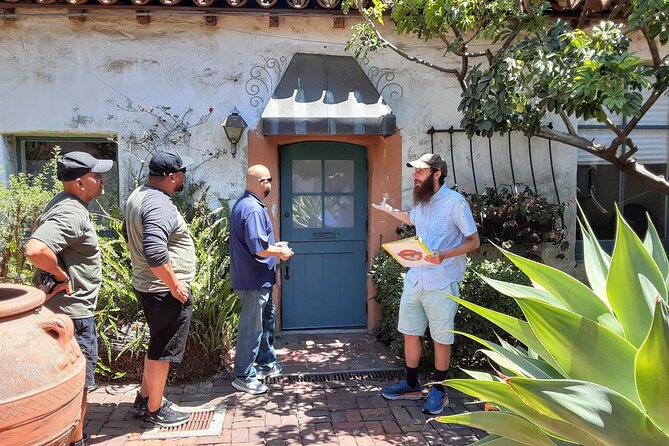
At 802 Anacapa Street, the buildings tell another story of preservation through layers. The structure was built in 1945 but incorporates two original Mexican-period adobes and the 1906 Nardi Hotel.
Behind it is a courtyard and garden, along with Presidio Street. This street is considered Santa Barbara’s earliest city street because it once formed part of the route from the waterfront to the Presidio and then onward to the Mission.
The official stop is about five minutes. That sounds brief, but it is enough to understand the point: Santa Barbara’s street pattern and buildings are tied to movement between the coast, military base, and Mission. A guide can help you see a modern street as an old route with several names and uses over time.
You continue along the adobes on East De la Guerra Street, built in 1849 by José de la Guerra, the fifth commander of the Presidio. They are examples of Mexican-Californio architecture and were later sold to Gaspar Orena. Orena’s descendants still own the structures.
This is where a private guide earns his keep. Without explanation, a line of low adobe buildings can blur into the general Spanish look of downtown. With the family connections and construction dates in mind, the buildings become evidence of shifting authority, ownership, and local identity.
Casa de la Guerra and the ceremonial center
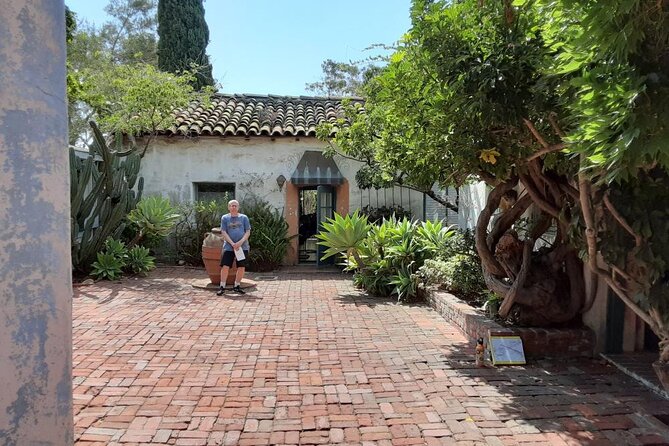
Casa de la Guerra is one of the tour’s key stops. Built in 1819 by José de la Guerra, it served both as a family mansion and as a business center. At the time, Santa Barbara consisted largely of adobes gathered around the Presidio, so this house was an important place for political and social activity.
The visit lasts about ten minutes, with admission included. Casa de la Guerra remains a central part of Santa Barbara’s public life and hosts Fiesta celebrations each summer. It is open to visitors on weekends, so your timing may determine how much of the interior you can see.
The building faces Plaza de la Guerra with City Hall and the News-Press Building. City Hall, completed in 1923 before the earthquake, is an early example of the Spanish Colonial Revival style. Hand-painted tiles, sidewalk arches, and a large California pepper tree give the block a strong civic character.
This is a useful place to understand that Santa Barbara’s Spanish appearance is partly old and partly a deliberate 20th-century choice. The city did not simply preserve every original building. After the 1925 earthquake, residents and designers shaped a new civic image based on Spanish and Mediterranean forms.
El Paseo’s passageways and the change after 1925
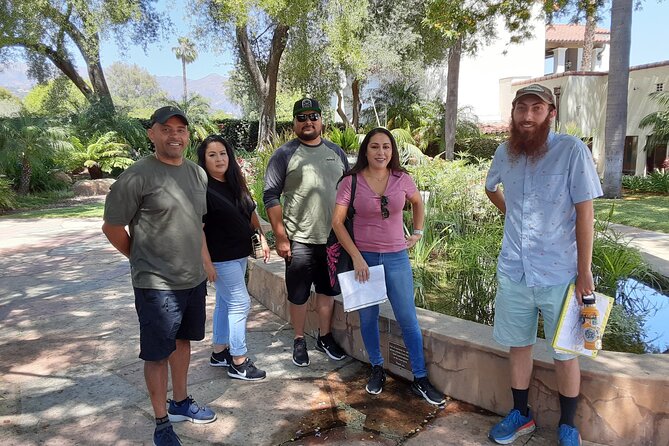
El Paseo provides one of the most enjoyable changes of pace. Built between 1922 and 1929, it helped shift Santa Barbara away from a standard Eastern American main-street look toward the Hispanic Pueblo style associated with the city today.
You wander through passageways, enter a romantic courtyard, and follow the Street in Spain before returning to State Street. The official stop lasts around five minutes, and admission is included. It is a compact visit, but the passageways and courtyard make a good visual break from the more formal historic sites.
I especially like this stop for travelers who want to understand Santa Barbara’s appearance rather than simply photograph it. The city’s Spanish character is not all a survival from the 18th or 19th century. Much of it reflects a conscious rebuilding and design movement in the years around the earthquake.
Along the way, the route passes several other notable buildings. Daniel Hill, one of the first American immigrants in Santa Barbara, built an unassuming private structure in 1825. It later hosted early City Council meetings in the 1850s and was restored in 1919.
You also see the Masonic Temple, decorated with carvings and frescoes, and a 1914 structure designed by J. Corbley Pool with an addition by Julia Morgan. That building is unusual because it is Santa Barbara’s only prominent brick structure.
Another Spanish-style building from 1926 was designed by Julia Morgan, the first woman to attend the École des Beaux-Arts in Paris. Morgan designed more than 700 buildings in California, and this example gives the walk another angle on the state’s architectural history.
Ending at El Cuartel, an 18th-century time capsule
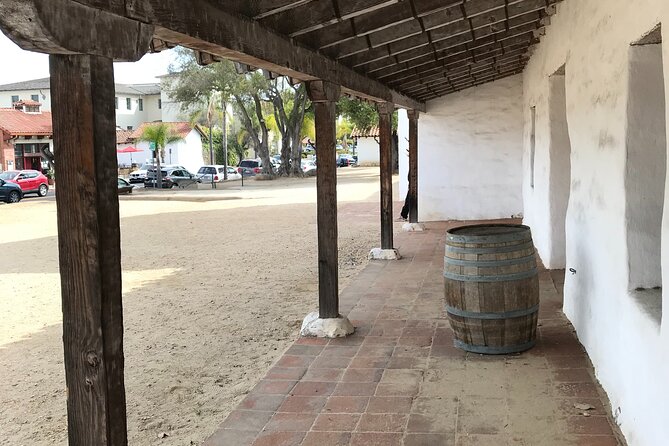
The tour ends at El Cuartel, at 122 East Canon Perdido Street, across from the starting point. Built in 1788, this small structure was part of the Presidio complex and is identified as the oldest building in town.
The official stop lasts about five minutes, with free admission. You can walk inside its rooms and back garden, where the structure has remained relatively unchanged. After the larger Presidio and the grander Casa de la Guerra, El Cuartel offers a more modest picture of daily life.
That ending works well. You begin with the military center of the settlement and finish with a small building that helps you imagine the people who lived and worked around it. The tour returns to the meeting point, so you do not need to arrange a ride back from another part of town.
What Sullivan Israel adds to the walk
Sullivan Israel is the key variable in this experience. The route has plenty of historic buildings, but the value of a private walk depends on how clearly those places are explained.
The available details point to a guide who uses old maps, historic photographs, and first-person accounts from the 18th and 19th centuries. He has a strong interest in architecture and connects design choices to the economic and social forces behind them.
I also appreciate the attention to difficult subjects. The story of Santa Barbara is not only one of elegant adobes and carefully painted tiles. The treatment of the Chumash under the mission fathers is part of the city’s past, and a useful tour should not skip it. At the same time, the approach described here appears to avoid turning the entire walk into a single-note account of suffering. You get context, change, and competing perspectives.
Since the activity is private, you can ask Sullivan to spend more time on architecture, military history, family stories, or the earthquake and rebuilding. The stated duration is flexible at about one to two hours, though the listed stop times add up to less than an hour. That suggests the remaining time is used for walking, questions, transitions, and extra explanation.
Timing, comfort, and practical value
This is a walking tour, so wear shoes suited to pavement and expect time outdoors. The route includes shaded courtyard stops, but the experience requires good weather. If poor weather cancels the tour, you are offered another date or a full refund.
The meeting point is El Presidio at 123 East Canon Perdido Street. Parking fees are not included, so factor that into your plans. The area is near public transportation, which may be useful if you do not want to park downtown.
The tour is offered in English and uses a mobile ticket. Confirmation arrives when you book. Service animals are allowed, and most people can take part, but the supplied information does not give a detailed accessibility assessment or identify the exact walking distance. If you have specific mobility needs, ask before booking.
The published schedule shows Sunday hours from 9:30 a.m. to 5:30 p.m. for the stated operating period. Check the available start time when you reserve, since the tour itself is private and scheduling may vary.
No price is provided here, so I cannot judge the exact cost against other Santa Barbara walks. I can judge the structure. A private guide, a flexible one to two hour format, included admission at the Presidio and Casa de la Guerra, and access to several lesser-seen sites can make this a good value for a couple, family, or small group that wants discussion instead of a fixed script.
The value is weaker if you only want a quick orientation or plan to spend most of your day inside museums. You are paying for interpretation, local detail, and the chance to ask questions, not for a long list of paid admissions.
Who should book this Santa Barbara walk
I would choose this tour if you care about architecture, local history, or the way a city changes over time. It is also a strong first-day activity because it gives you a mental map of the Presidio district, Plaza de la Guerra, El Paseo, and State Street.
It suits families and mixed-age groups because the private format lets you adjust the conversation. It also works well for repeat visitors and locals. The buildings may be familiar, but the construction details, old photographs, and family connections can change how you see them.
I would be more cautious if you want a long museum visit, a food-focused walk, or a tour centered on the beach and waterfront. This experience stays focused on El Pueblo Viejo, adobe buildings, civic architecture, and Santa Barbara’s early development.
One note deserves attention: generic promotional wording sometimes pairs Santa Barbara material with references to New Orleans, the French Quarter, or Voodoo. Those subjects do not match this Santa Barbara route. The actual experience described here is a walk through El Pueblo Viejo, the Presidio district, Spanish and Mexican California sites, and later Spanish-style architecture.
Should you book it?
Book this private walk if you want Santa Barbara’s buildings to make sense, not just look pretty. Sullivan Israel’s use of maps, photographs, architecture, and difficult historical context gives the tour more substance than a quick photo stop.
Skip it if you prefer to explore quietly on your own or want a longer visit inside each museum. For most history-minded visitors, though, the short route is a smart introduction. Start here, then return to the Presidio, Historical Museum, or Casa de la Guerra with a better understanding of what you are seeing.
FAQ
How long does the Private Walking Tour of El Pueblo Viejo last?
The tour lasts approximately one to two hours. The walking time includes several short stops, transitions between sites, and time for questions.
Where does the tour begin?
It begins at El Presidio de Santa Bárbara State Historic Park, at 123 East Canon Perdido Street in Santa Barbara, California.
Where does the tour end?
It ends back at the meeting point. The final stop is El Cuartel at 122 East Canon Perdido Street, across the street from where the tour begins.
Who leads the tour?
The experience provider and guide is Sullivan Israel.
Is the tour private?
Yes. Only your group participates in the activity.
What language is offered?
The tour is offered in English.
Is admission included?
Admission is included at El Presidio de Santa Bárbara State Historic Park and Casa de la Guerra. Some other stops are free, while museum entry may be optional.
Are parking fees included?
No. Parking fees are not included.
Can I cancel for a full refund?
Yes, if you cancel at least 24 hours before the experience start time. Cancellations made less than 24 hours in advance are not refunded, and changes within that period are not accepted.
What happens if bad weather cancels the tour?
The experience requires good weather. If it is canceled because of poor weather, you will be offered a different date or a full refund.
Just added around Santa Barbara
- Gaviota Coast Near Santa Barbara: Kayak Tour (3.5 Hours)★ 5.0 · 3 reviews
- Guided Hiking, Biking and Tennis★ 5.0 · 3 reviews
- Downtown Santa Barbara Food and Drinks Tour★ 4.5 · 3 reviews
- 3-Winery Santa Ynez Tour with Picnic Lunch from Santa Barbara★ 5.0 · 3 reviews
- Santa Barbara Sunset Cruise on Yacht with Full Bar★ 4.5 · 3 reviews
- Santa Barbara Scavenger Hunt Adventure★ 4.0 · 3 reviews
- Santa Barbara Historical and Architectural Private Tour★ 4.5 · 3 reviews
- Private Wine Tour from the Santa Ynez Valley★ 5.0 · 3 reviews
Walking Tours, compared.
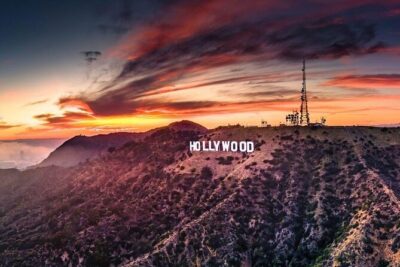
Los Angeles Original 90-Minute Walking Tour to The Hollywood Sign
Read our review →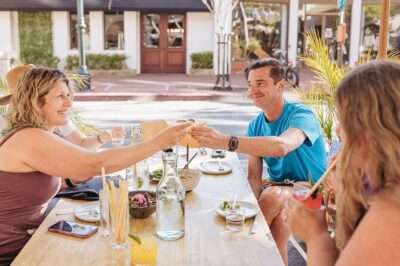
The ORIGINAL Downtown Santa Barbara Walking Food & Drink Tour
Read our review →
Hollywood Stars Tour: Walk of Fame, Celebrity Homes, Sunset Strip
Read our review →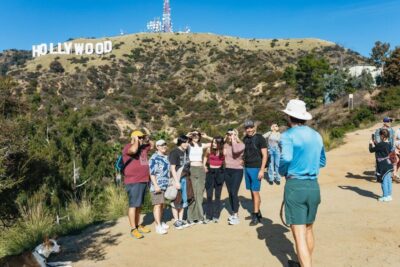
Express Hollywood Sign Guided Walking Tour with Photos
Read our review →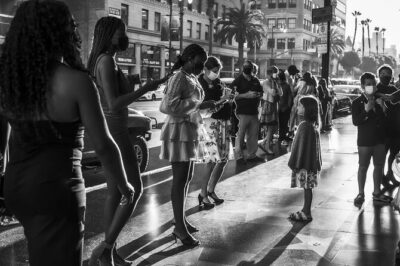
Haunted Hollywood Walking Tour: True Crime and Creepy Tales
Read our review →
Walk of Fame, Hollywood Sign & Beverly Hills Tour
Read our review →Browse the lists this tour appears in