

Reviewed · NATIONAL PARKS
Death Valley National Park Self-Guided Audio Driving Tour
Death Valley is a place where the scenery changes faster than you expect. One moment you are crossing pale salt flats, and the next you are looking across red badlands or strange volcanic hills. This self-guided drive adds more than 55 audio stories to an 80-plus-mile route, giving you context while you move between the park’s major sights.
I especially like the per-car price, which makes this far cheaper than a guided vehicle tour for a couple or small family. I also like the offline design: once you download the route on strong service, the GPS can trigger stories even when your phone shows no bars. The main catch is technical preparation. If you choose the wrong starting version or fail to download everything beforehand, the tour can be frustrating to use.
In This Review
- Key things to know before you go
- A good way to make sense of Death Valley
- Death Valley Junction and the borax story
- Dante’s View and the scale of Badwater Basin
- Twenty Mule Team Canyon and Zabriskie Point
- Furnace Creek, Mars Hill, and the heat factor
- Artist’s Palette and Devils Golf Course
- Badwater Basin, the lowest point in North America
- How the app performs away from cell service
- Price, timing, and who gets the best value
- Should you book the Death Valley audio tour?
- FAQ
- How much does the Death Valley audio tour cost?
- How long does the tour take?
- Does the tour work without cell service?
- Where can I start the tour?
- What does the tour include?
- Can I cancel for a full refund?
Key things to know before you go
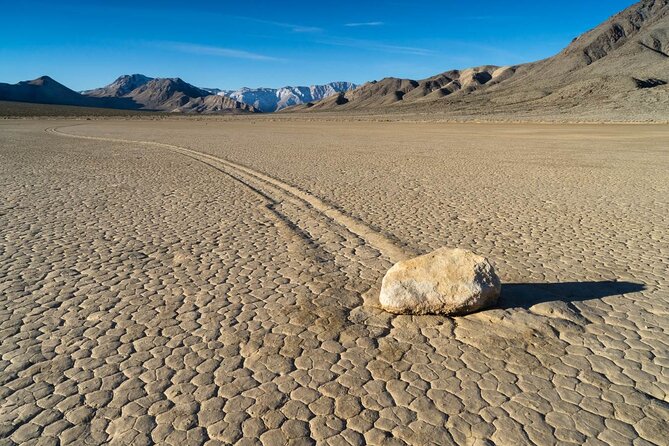
- More than 80 miles of driving: Plan on roughly four to five hours for the main route, without rushing your photo stops or walks.
- Four travelers can share one purchase: The $16.99 price covers a group of up to four people in one car.
- Offline use is essential: Download the Action Tour Guide app and tour while you still have strong cellular or Wi-Fi service.
- The route covers major Death Valley sights: Expect stories near Dante’s View, Zabriskie Point, Furnace Creek, Artist’s Palette, Devils Golf Course, and Badwater Basin.
- You control the day: Start, pause, skip, or repeat sections, and use the tour over multiple days because access does not expire.
- The park pass costs extra: Your Death Valley entrance fee is not included, though that pass is valid for seven consecutive days.
A good way to make sense of Death Valley
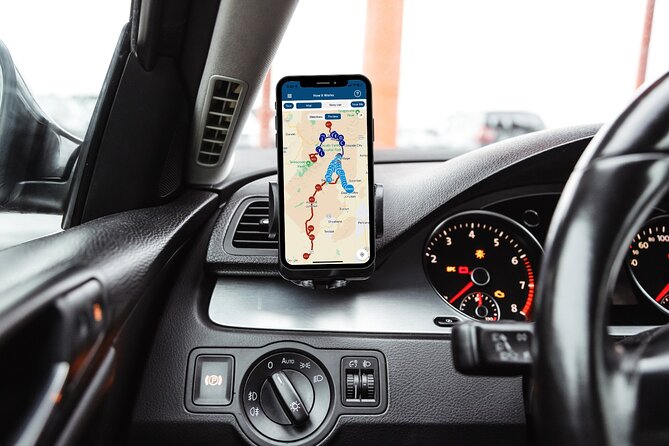
A self-guided audio tour works particularly well here because Death Valley is huge and its sights are spread far apart. You spend plenty of time driving between viewpoints, trailheads, and roadside stops. A narrator fills those stretches with stories about geology, mining, heat, and the people who tried to make a living in this harsh basin.
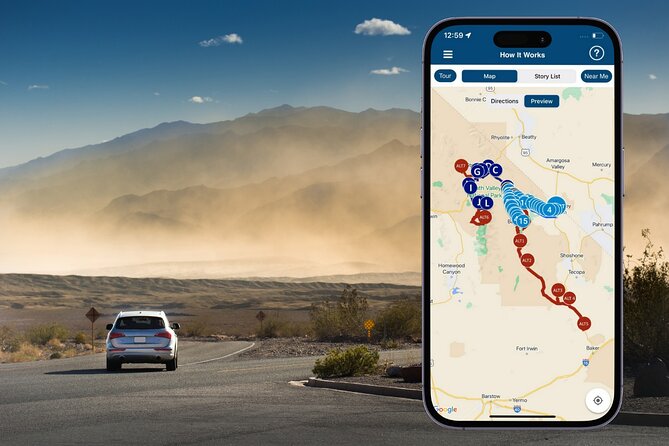
The format is simple. You download the separate Action Tour Guide app, enter the password sent by email and text, and select the version that matches your entrance point and direction. Once you reach the first story location, the audio should begin on its own. As you continue along the route, the next story plays when you reach its GPS point.
That hands-free setup means you do not need to keep checking your screen. You can connect your phone to the car through Bluetooth, USB, or AUX. Apple CarPlay supports audio playback, while Android Auto and navigation support are listed as upcoming features, so do not assume the app will behave like a full in-dash navigation system.
The tour has versions for several approaches, including Death Valley Junction at the east entrance, Furnace Creek Visitor Center, Beatty’s Entrance from the north, and Towne Pass from the west. Choose the correct version before you start. Starting at the wrong point can leave you trying to catch up with stories that already played.
More desert runs out of the city:
- Death Valley National Park Self-Guided Audio Tour
★ 4.5 · 5 reviews - LA: Las Vegas, Sedona, Monument, Antelope Canyon, 5-Day Tour
★ 4.5 · 7 reviews - Grand Canyon and Lower Antelope Canyon 4-Day Tour from LA
★ 3.5 · 3 reviews
Death Valley Junction and the borax story
The route begins at Death Valley Junction for one version of the tour. This is a useful opening because it introduces the region before you reach the park’s most famous viewpoints. The narration sets up Death Valley as both an extreme natural place and a site shaped by human ambition.
The early story about borax is one of the more memorable pieces of context. The Gold Rush drew hopeful miners west, but gold was not the mineral that kept Death Valley economically important. Borax became the prize, and the famous twenty-mule wagon teams hauled it through the desert.
That background gives the later stops more meaning. When you reach Twenty Mule Team Canyon, you are not simply looking at colorful hills. You are seeing terrain connected to the difficult transport system that helped move borax out of the valley.
The first audio segment is listed at about five minutes, but the whole experience is not five hours of continuous narration. You will hear short stories at set points, with plenty of driving between them. That pacing is helpful in a hot park, since you can listen from the shade of your vehicle and decide which stops deserve a longer break.
Dante’s View and the scale of Badwater Basin
Dante’s View is one of the best places to understand Death Valley’s enormous size. The viewpoint sits more than 5,000 feet above Badwater Basin, near the Black Mountain Range. From there, the salt flats spread out below while the Panamint Mountains frame the distance.
The audio points out the relationship between the high overlook and the low basin. That contrast is the point of the stop: you are not just looking at a pretty view, you are seeing the dramatic change in elevation that defines this part of the park.
Bring your camera, but give yourself time simply to look. Dante’s View is also described as a good place for sunset, when the light reaches across the basin and Panamint Mountains. Since the tour lets you pause whenever you want, you are not tied to a group timetable.
The practical issue is that the day can easily grow longer than the advertised four to five hours if you include every side trip, photo stop, and walk. You should treat that duration as a guide for the driving route, not a strict schedule.
Twenty Mule Team Canyon and Zabriskie Point
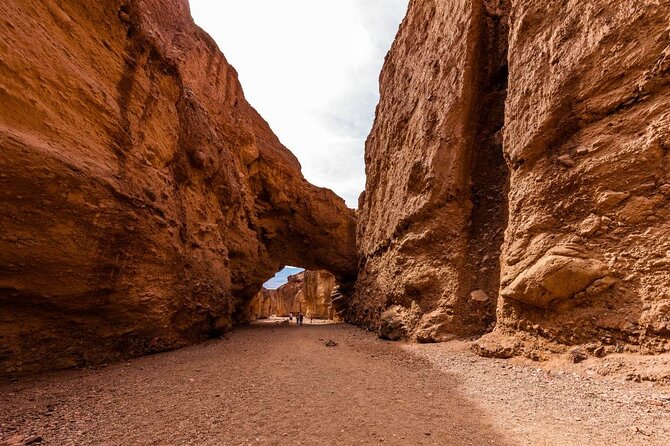
Twenty Mule Team Canyon offers a winding road through saffron-colored hills and badlands. The changing colors are especially strong in early morning or near sunset, when low light brings out the folds and ridges in the rock.
Road conditions matter here. The tour describes the road as rugged and unpaved, so drive carefully and follow park guidance. The audio can explain what you are seeing, but it cannot replace attention to the road.
Zabriskie Point gives you a different angle on the same forces. From the overlook, eroded badlands fill the foreground, pale salt flats appear farther away, and the Panamint Mountains rise beyond. The view makes erosion easy to read, even if geology is not normally your interest.
The stop is named for a nineteenth-century borax baron, tying the scenery back to the mining story from the start of the route. That connection is one of the tour’s strengths. Instead of presenting each viewpoint as an isolated photo stop, the narration links geology, minerals, industry, and place names.
Zabriskie Point is also one of the spots where the tour can help first-time visitors decide where to spend time. The view is immediately accessible, while nearby routes and additional stops may require more planning. You can listen to the story, take in the overlook, and then decide if you want to continue or explore farther.
A few more Palm Springs trips worth weighing up
- Joshua Tree National Park Self-Guided Driving Audio Tour
★ 4.5 · 762 reviews - Joshua Tree National Park Scenic Tour
★ 4.5 · 499 reviews - Joshua Tree National Park Offroad Tour
★ 5.0 · 427 reviews - Joshua Tree National Park Driving Tour
★ 5.0 · 296 reviews
Furnace Creek, Mars Hill, and the heat factor
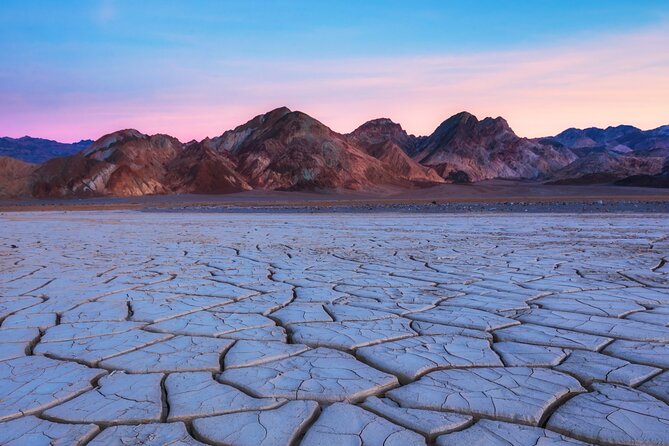
Furnace Creek Visitor Center is a practical stop as well as a tour highlight. You can find snacks, water, and restrooms, and a large digital thermometer outside shows the temperature. A photo beside the readout is a good way to document the conditions, especially if this is your first visit to one of the hottest places on Earth.
The visitor center also gives you a chance to reset. Four or five hours in Death Valley can be tiring, and the combination of heat, driving, and short walks adds up quickly. Use the flexibility of the app to pause here rather than trying to keep the audio moving at all costs.
Mars Hill is a smaller feature, but the name makes sense as soon as you see the dry, ochre-colored stones and dusty ground. The narration uses it to explain why parts of Death Valley can feel almost extraterrestrial. It is a short story, yet it helps you notice textures and colors you might otherwise pass without a second look.
The audio content also touches on volcanic deposits, iron oxides, chlorite, and the way these materials shaped the colors of the rock. That detail is useful at later stops because it reminds you that not every red, yellow, or green patch formed in the same way.
Artist’s Palette and Devils Golf Course
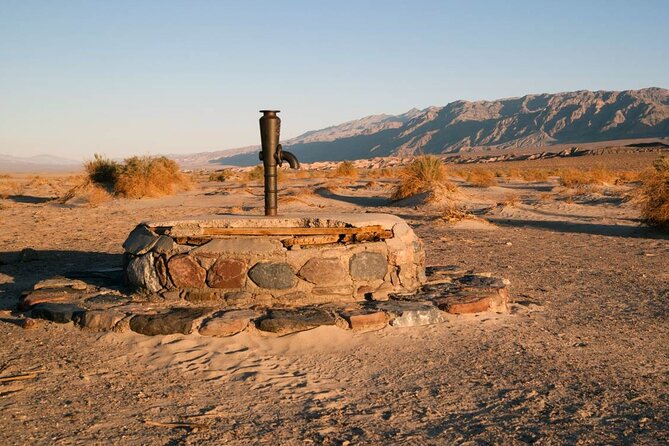
Artist’s Palette is best viewed from the designated roadside area described by the tour. The rock colors can look artificial, with streaks and patches that seem painted across the hills. The narration explains that volcanic deposits helped create these tones, offering a different geological story from the sedimentary badlands near Zabriskie Point.
This is a good example of audio guiding doing more than pointing out a famous name. You get a reason to compare the colors and textures instead of simply taking a quick photograph and moving on.
Devils Golf Course is another contrast. Rather than smooth turf and green hills, you find a rough field of salt formations and jagged ground. The road leading there is rugged and unpaved, so caution is important. Check current park conditions before setting out, and do not assume every route is open.
The name is playful, but the surface is not. Watch your footing if you leave the vehicle, and remember that heat can make a short walk feel much harder than it looks. The tour’s ability to pause is valuable here, since you can listen, look around, and continue only when you are ready.
Badwater Basin, the lowest point in North America
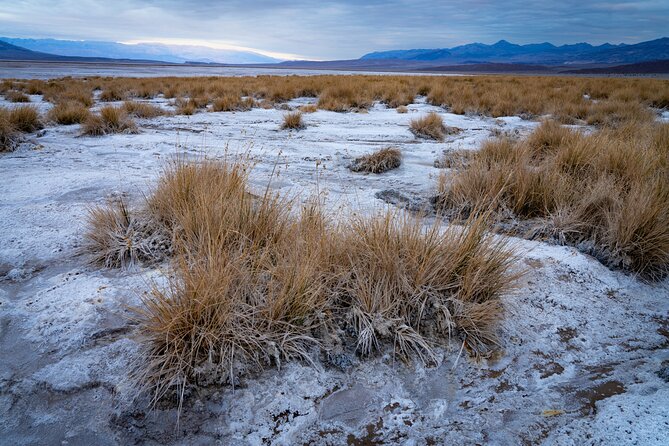
Badwater Basin is the route’s major finale for many visitors. The salt flats cover roughly 200 square miles, and the basin sits 282 feet below sea level, the lowest point in North America.
The scale can be hard to grasp from photographs. Standing near the basin, you see a broad white floor extending toward the surrounding mountains. The audio provides the basic geographic context, while the open view supplies the drama.
Badwater is also where heat planning matters most. Carry water, limit exertion, and use the vehicle for shade when needed. The tour does not include a guide who can monitor your group, so you are responsible for pacing and safety.
The route descriptions also include access to the Golden Canyon trail from the Furnace Creek area. The out-and-back walk is about three miles and takes around an hour. It is a popular trail, but the important point is that the stated tour time does not include this walk. Add it only if conditions and your energy level make sense.
How the app performs away from cell service
The strongest feature is the offline playback, but only if you set it up correctly. Download the Action Tour Guide app and the specific tour while you have a strong connection. Open the route before driving into the park, confirm that the stories are available, and connect the phone to your car stereo.
Death Valley has areas with little or no cellular service. The app is designed to use GPS rather than a live data connection once the content is downloaded. That can work very well, but it is not magic if the tour was never saved to the phone.
Keep the booking email and text available before leaving service. They contain the setup instructions and password. If more than one tour version appears in the app, select the starting point that matches your actual entrance.
A few technical problems are possible. Audio may fail to trigger if you are not at the correct starting point, if the wrong direction was selected, or if the app was not fully downloaded. If that happens, contact support. Do not wait until you are deep inside the park to troubleshoot.
The tour is compatible with an iPhone running iOS 15 or later, an Android device running version 9 or later, or an iPad or tablet with GPS and cellular capability. Headphones may help when you walk away from the car, though the car stereo is the better choice while driving.
Price, timing, and who gets the best value
At $16.99 per group of up to four, the cost is low for a private experience. A family or group of friends can split the price, making it much cheaper than paying individual admission for a bus or guided tour. You still need to pay the national park entrance fee separately.
The seven-day park pass is useful if you want to return or spread the route over multiple days. The audio access itself does not expire, so you can use it again on a later trip. That is a real benefit for anyone driving through Death Valley more than once or approaching from a different entrance.
The tour is best for independent visitors who want direction without a fixed group. You decide when to stop for water, photos, food, or a trail. You can skip a story, repeat one, or pause the route for a side trip.
It is less suited to anyone who does not want to manage an app. You need your own vehicle, your own entrance pass, and some patience with setup. It also does not replace official park information, road alerts, or sound judgment in extreme heat.
The listed operating period runs from May 23, 2022, through February 24, 2027, with hours shown as 8:00 a.m. to 5:00 p.m. Conditions in Death Valley can change quickly. Recent flooding has affected Badwater Road, North Highway, and Bonnie Clare Road, and access for pedestrians and cyclists may be limited during repairs. Check official park alerts before leaving and again on the day of your visit.
Should you book the Death Valley audio tour?
I would book it if you are making a first visit, driving your own car, and want useful stories without paying for a private guide. The borax connection, GPS-triggered narration, offline maps, and stops at Zabriskie Point, Artist’s Palette, and Badwater Basin give you a solid route through the park’s main sights.
I would skip it if you are unwilling to download and test the app before entering Death Valley. The experience depends on correct setup, and the lack of cell service leaves little room for fixing mistakes on the road.
For most small groups, the price is easy to justify. Download it on strong Wi-Fi, select the right entrance version, check road closures, bring water, and leave room in your schedule for the views. That combination gives you the freedom of a solo road trip with enough narration to make the long drive more meaningful.
FAQ
How much does the Death Valley audio tour cost?
The tour costs $16.99 per group of up to four people. The Death Valley National Park entrance fee is separate and is not included.
How long does the tour take?
The driving route covers more than 80 miles and usually takes about four to five hours. Extra time is needed for photographs, meals, breaks, side trips, and the Golden Canyon walk.
Does the tour work without cell service?
Yes, it is designed to work offline after you download the app and tour content using strong Wi-Fi or cellular service. GPS-triggered stories can then play without a live connection.
Where can I start the tour?
Available versions include Death Valley Junction at the east entrance, Furnace Creek Visitor Center, Beatty’s Entrance from the north, and Towne Pass from the west. Choose the version that matches your actual starting point and direction.
What does the tour include?
It includes English audio stories, offline maps, GPS-triggered playback, hands-free guidance, and flexible start and pause options through the Action Tour Guide app. Park admission, food, and other personal costs are not included.
Can I cancel for a full refund?
Yes. You can receive a full refund if you cancel at least 24 hours before the experience start time. Cancellations or changes made within 24 hours are not refunded.
More Audio Tours in Palm Springs
- Self Guided Driving Audio Tour of Palm Springs
★ 3.5 · 8 reviews - Joshua Tree National Park Self-Guided Audio Tour
★ 3.0 · 5 reviews - Journey into Joshua Tree On-Demand Audio Tour and Locals Guide
★ 3.5 · 3 reviews - 100+ Self-Guided Audio Tours: Driving & Walking Bundle
★ 3.5 · 3 reviews
More Self-Guided Tours in Palm Springs
- Palm Springs Self-Guided Driving Audio Tour
★ 4.0 · 211 reviews - Palm Springs and Joshua Tree Self-Guided Driving Audio Tours
★ 4.0 · 43 reviews - Self-Guided Driving Audio Tour in Joshua Tree National Park
★ 4.5 · 20 reviews - Palm Springs Team Trivia Hunt: New 2024 Mobile Game App!
★ 4.0 · 15 reviews
Just added around Palm Springs
- All-In-One California Self-Guided Driving & Walking Bundle Tour★ 4.5 · 3 reviews
- Palm Springs: Indian Canyons Jeep/Hiking Combo Tour★ 5.0 · 3 reviews
- Rock Climbing Trips in Joshua Tree National Park (8 Hours)★ 5.0 · 3 reviews
- Journey into Joshua Tree On-Demand Audio Tour and Locals Guide★ 3.5 · 3 reviews
- 100+ Self-Guided Audio Tours: Driving & Walking Bundle★ 3.5 · 3 reviews
- Palm Springs Shuffle Scavenger Hunt★ 5.0 · 4 reviews
- Make Sun Prints in the Desert★ 5.0 · 4 reviews
- Private Abstract Painting Workshops in Palm Springs★ 5.0 · 4 reviews
National Parks, compared.
Half-Day Guided Hike in Joshua Tree National Park
Read our review →
Joshua Tree National Park Sightseeing Adventure Tour
Read our review →
Beginner Group Rock Climbing in Joshua Tree National Park
Read our review →
Private 1-Hour Archery Session Near Joshua Tree National Park
Read our review →Browse the lists this tour appears in