
Reviewed · NATIONAL PARKS
Death Valley National Park Self-Guided Audio Tour
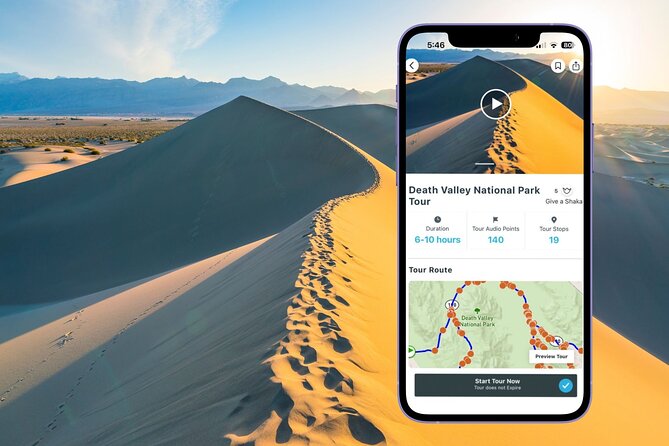
Death Valley is too large for a quick look from one scenic overlook. This self-guided audio tour turns your car into a private guide, leading you from the Mesquite Flat Sand Dunes and Badwater Basin to old borax works, narrow canyons, and high mountain viewpoints. The narration starts automatically as you drive, so you can keep your eyes on the road.
I like the offline GPS system, which matters in a park where cell service can vanish. I also like the one-price setup: $12.79 covers a group of up to 15 people, rather than charging each person. The main consideration is that you provide the car, park entrance fee, fuel, food, and most of the time. The advertised six to eight hours can become a full day if you take the longer hikes.
In This Review
- Key Points Before You Drive
- How the Shaka Guide Tour Works on the Open Road
- Emigrant Canyon’s Mining Remains and Charcoal Kilns
- Stovepipe Wells and the Mesquite Flat Sand Dunes
- Salt Creek and the Borax Story at Furnace Creek
- Salt, Rock, and the Lowest Point in North America
- Artist’s Drive and Golden Canyon
- Zabriskie Point and Twenty Mule Team Canyon
- The High View at Dante’s View
- Price, Time, and Practical Value
- Who Should Book This Audio Tour?
- Should You Book the Death Valley Audio Tour?
- FAQ
- How much does the Death Valley self-guided audio tour cost?
- How long does the tour take?
- Where does the tour start?
- Do I need my own car?
- Does the audio tour work without cell service?
- Is the park entrance fee included?
- Can I choose which stops to visit?
- Is the tour offered in English?
- Is this a private tour?
Key Points Before You Drive
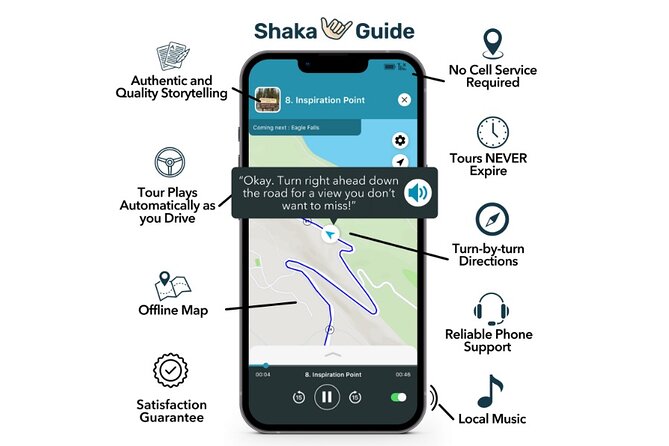
- Offline audio and maps: Download everything on strong Wi-Fi, then use the app without mobile data or a signal.
- A private tour for up to 15 people: One purchase works for the entire vehicle, making the price especially good for families and small groups.
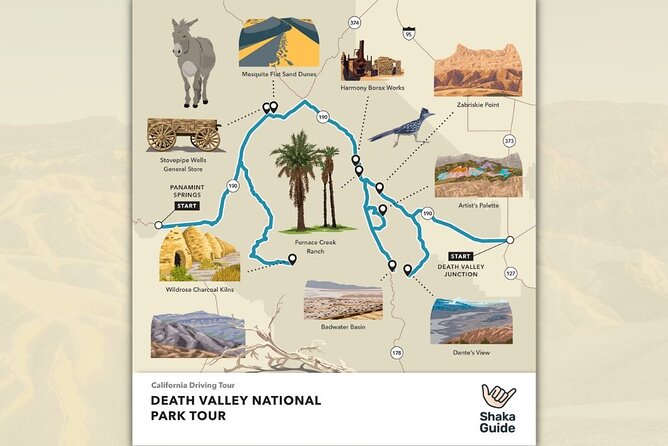
- Two possible starting points: Begin near Death Valley Junction or use the optional west entrance starting point near Panamint Springs.
- Big highlights and small oddities: The route includes Badwater Basin, Zabriskie Point, Dante’s View, Devils Golf Course, the Charcoal Kilns, and the strange Devils Cornfield.
- Flexible timing: Pause, skip stops, or continue over more than one day. The tour does not expire.
- Plan for your own costs: You need private transportation, park admission, fuel, meals, and any parking or entrance charges.
How the Shaka Guide Tour Works on the Open Road
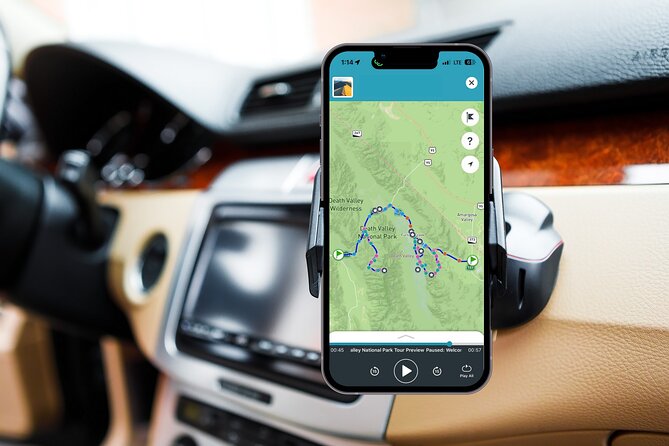
After booking, you receive confirmation and instructions to download the Shaka Guide app. Use the redemption code in the email, open the My Stuff section, choose the Death Valley tour, and download the route before you leave reliable Wi-Fi.
Once you select a starting point, GPS activates the narration, directions, music, and road alerts as you drive. The audio can work without Wi-Fi or cellular service. That is more than a small convenience here. Death Valley is enormous, and a lost signal should not leave you guessing about the next turn.
The narration includes park stories, history, travel tips, activity suggestions, and restaurant advice. It also warns you about upcoming curves and roads, which is useful on the park’s winding routes. One practical way to use it is to play the narration through your car speakers while driving, then switch to headphones such as Shokz when walking. If two people want separate Bluetooth headsets, an AirFly adapter can allow both to listen, though that accessory is not included.
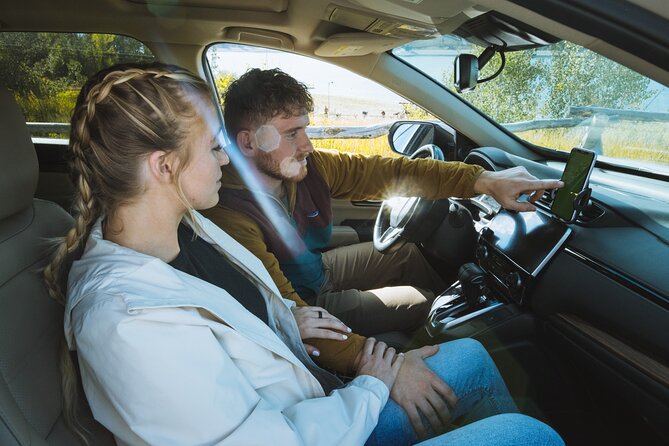
The tour is private, but it is not a private vehicle service. You drive yourself, choose your pace, and decide how long to stay. The app is a helpful companion, not a substitute for checking current road conditions or carrying enough water and fuel.
More desert runs out of the city:
- Death Valley National Park Self-Guided Audio Driving Tour
★ 4.0 · 33 reviews - LA: Las Vegas, Sedona, Monument, Antelope Canyon, 5-Day Tour
★ 4.5 · 7 reviews - Grand Canyon and Lower Antelope Canyon 4-Day Tour from LA
★ 3.5 · 3 reviews
Emigrant Canyon’s Mining Remains and Charcoal Kilns
The optional Emigrant Canyon detour begins with Journigan’s Mill, the remains of an early twentieth-century processing plant. Foundations, empty tanks, and scattered industrial pieces are all that remain. It is a brief stop, about 10 minutes, and the appeal is strongest if you enjoy photography, old machinery, or small traces of mining life.
Next comes Wildrose Campground, a former Civilian Conservation Corps site. Only about five minutes are suggested here, but you can stretch your legs and look at the surviving campground buildings beside the road. This is a modest stop, not a major attraction, yet it adds a human chapter to a drive that otherwise focuses heavily on geology.
The Charcoal Kilns are the payoff for this detour. Ten large, beehive-shaped kilns sit high in the Panamint Range, lined up in a row. You can step inside one, and the old charcoal smell may still be noticeable. Allow about 10 minutes, though the long drive toward the kilns makes this option take much more time than the stop lengths suggest.
Check road conditions before taking this detour. The route can add substantial driving, and the tour’s flexible format lets you save it for another day if your main goal is Badwater Basin and the central valley.
Stovepipe Wells and the Mesquite Flat Sand Dunes
Stovepipe Wells is a practical checkpoint. If you need gasoline or a meal in the northern part of the park, this is one of the places to handle it. Visitor services and accommodation are available, and the tour allows about 30 minutes.
The Mesquite Flat Sand Dunes are the only true sand dunes on this route. You can see them from the parking area, but walking out among the ridges and mesquite trees gives you a much better sense of their size and shape. A short visit may be enough for photographs, while sunset and stargazing are especially well suited to this location.
Do not judge the dunes only from the road. The best views change as you walk, and the tour gives you the freedom to wander rather than forcing a strict group schedule. Still, 15 minutes is only enough for a quick look. Give yourself longer if the dunes are a priority.
Nearby Devils Cornfield is a quick curiosity. A patch of arrowweed grows in clumps that can look like rows of corn. There is a small parking area, but the attraction is brief, with about five minutes suggested. It is a fun roadside oddity, not a destination that deserves a major detour.
Salt Creek and the Borax Story at Furnace Creek
Salt Creek Interpretive Trail offers a change from the dry salt flats and bare rock. A half-mile boardwalk crosses a wetland that serves as a watering place for wildlife and habitat for the endangered Salt Creek pupfish. The easy trail is reached by a dirt road, and the suggested visit is about 15 minutes.
At Harmony Borax Works, you can see the remains of an early mining operation and follow a short path with signs explaining how borax was processed. A surviving wagon recalls the famous 20-mule teams that hauled borax from Death Valley. This stop takes about 15 minutes and gives useful context to the abandoned industrial structures elsewhere in the park.
Furnace Creek Visitor Center deserves a longer stop than its five-minute listing might suggest. It has information, flush toilets, water refill facilities, and a museum covering Death Valley’s natural and human past. I would use it to check road conditions, refill water, and adjust the day’s plan before heading south.
The Ranch at Death Valley is the park’s main service center. You can buy gasoline, eat at a buffet-style restaurant, stop for ice cream, or visit the Wild West-themed saloon. The General Store sells souvenirs and includes a small grocery section. The Borax Museum adds another look at mining history.
Prices are higher inside the park, so use Stovepipe Wells or Furnace Creek with a plan. Furnace Creek is also the only place listed on this route for both a meal and gas within the park, making it an important practical stop rather than a simple sightseeing break.
A few more Palm Springs trips worth weighing up
- Joshua Tree National Park Self-Guided Driving Audio Tour
★ 4.5 · 762 reviews - Joshua Tree National Park Scenic Tour
★ 4.5 · 499 reviews - Joshua Tree National Park Offroad Tour
★ 5.0 · 427 reviews - Joshua Tree National Park Driving Tour
★ 5.0 · 296 reviews
Salt, Rock, and the Lowest Point in North America
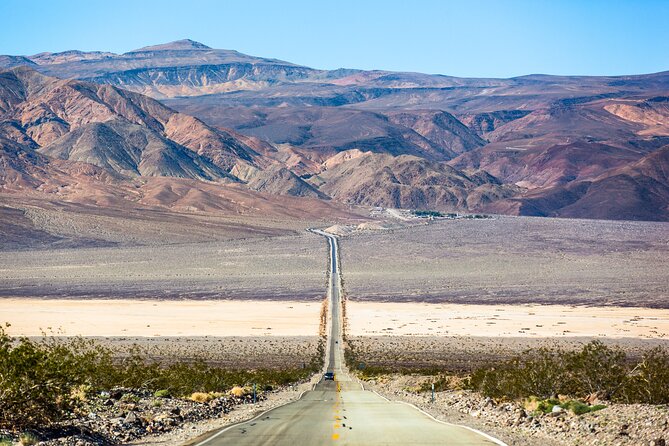
Devils Golf Course sits down a short dirt road from Badwater Road. Its salt surface forms jagged, irregular shapes that look nothing like a normal playing field. There is no formal trail, and sturdy shoes are a good idea because the salt can hurt if you step carelessly.
Badwater Basin is the essential stop. At the lowest point in North America, the salt flats stretch across a broad, stark basin framed by high mountains. A boardwalk starts near the parking area, but you can continue on the Badwater Basin trail.
The geometric salt formations are about one mile from the parking area, making the walk roughly two miles round trip. The suggested 30-minute stop suits the boardwalk and a short look, not the full walk to the more pronounced salt shapes. Build in extra time if this is your main reason for visiting Death Valley.
Natural Bridge Trail is another short walk, about one mile round trip. The route is flat but rocky, leading to a natural bridge formation. Thirty minutes may work for a brisk outing, but comfortable shoes will make this stop easier.
Artist’s Drive and Golden Canyon
Artist’s Drive is a one-way road that climbs into the Black Mountains through a twisting canyon. The drive itself is the attraction, with tight bends and changing rock colors. The key pullout is Artists Palette, where different minerals tint the cliffs in shades of color.
This road is best enjoyed slowly. Its one-way design means you should follow the suggested direction and stay alert on curves. A 30-minute visit includes the drive and a short walk at Artists Palette, though the audio warnings are particularly useful here.
Golden Canyon Trailhead gives you the chance to trade the car for a longer walk. The route passes through a stark canyon toward the Red Cathedral cliff formation. The round trip is about three miles, or five kilometers, and the suggested time is one hour.
That hour is a reasonable minimum for a steady hike, but it leaves little room for lingering. If you want both Golden Canyon and the other major stops, start early and be selective. The tour lets you hear the guidance while driving, then pause it for your hike.
Zabriskie Point and Twenty Mule Team Canyon
Zabriskie Point is one of Death Valley’s most recognizable overlooks. From the paved viewpoint, you look across folded badlands toward Red Cathedral and Manly Beacon. The walk from the parking area is short but steep, so it is not completely effortless.
The site also has links to film history and was used as the album-cover setting for U2’s Joshua Tree. Those details give the view a cultural layer, but the eroded rock formations remain the main reason to stop. Allow about 20 minutes.
Twenty Mule Team Canyon is another optional dirt-road detour. Like Mustard Canyon, it winds through a tightly curving canyon and takes about 15 minutes beyond the main route. The road is usually reasonably maintained, but it is bumpy and not recommended for low-clearance vehicles.
Check park conditions before entering. Neither Twenty Mule Team Canyon nor Mustard Canyon has a single major viewpoint, so skip them if road conditions are poor or if you would rather spend your time walking at Badwater Basin and Golden Canyon.
The High View at Dante’s View
Dante’s View provides one of the tour’s biggest changes in scale. The road climbs more than 5,000 feet to an overlook above Badwater Basin. From the top, you can see the low salt basin below, the Panamint Range across the valley, and, on clear days, the Sierra Nevada and Mount Whitney.
The contrast is the point. At Badwater, you stand at the bottom of North America. At Dante’s View, you look down on that same basin from the mountains. Allow about 30 minutes, though this is a good place to stay longer if sunset or stargazing fits your schedule.
The elevation can bring different conditions from the valley floor, so check the day’s road status before making the climb. The tour’s GPS directions help, but park information remains the final word on closures and access.
Price, Time, and Practical Value
At $12.79 per group of up to 15 people, this is a low-cost way to add structure to a self-drive day. A couple pays the same as a large family, which makes the tour particularly good value when several people share one car.
You still need to pay the park’s optional $30 per-vehicle entrance fee, plus your own fuel, food, refreshments, transportation, and any applicable parking or entrance charges. The audio tour does not include a driver, vehicle, or in-person guide.
The bigger value is flexibility. You can start at Death Valley Junction, use the optional west entrance near Panamint Springs, pause the route, skip stops, and resume later. The tour never expires, so you do not have to force every canyon, trail, and overlook into one day.
The six to eight hour estimate works best for a scenic drive with short stops. Add Badwater’s two-mile walk, Golden Canyon’s three-mile hike, the Emigrant Canyon detour, and the two dirt-road options, and you will need more time. Treat the time estimate as a suggested driving framework, not a promise that every stop can be explored fully.
Who Should Book This Audio Tour?
I would choose it if you want independence but still appreciate direction, context, and reminders about upcoming turns. It suits couples, families, and small groups sharing a car, especially when the $12.79 group price is split among several people.
It is also a strong fit if you are visiting on your own schedule. You can make the tour a single long day, use only the southern highlights, or return on another day because the downloaded route does not expire.
I would hesitate if you want personal conversation, detailed answers at every viewpoint, or transportation from Palm Springs. The app cannot replace an in-person guide, and the narration may be more useful while driving than while standing at a site. For walkers, it is smart to pause the audio and explore on your own, then resume when you return to the car.
The tour has a 4.4 rating from five recorded ratings, and its strongest practical qualities are clear: it works without cell service, starts from your location, gives road warnings, and allows flexible stopping. Download it early, bring water, plan fuel at Stovepipe Wells or Furnace Creek, and check road conditions before the dirt roads and mountain detours.
Should You Book the Death Valley Audio Tour?
Book it if you want a cheap, private road companion that keeps your day organized without putting you on a schedule. The offline map and automatic GPS narration are especially useful in a park where service can disappear, and the one-group price is hard to beat.
Skip it if you expect a vehicle, a human guide, or a fully guided walking experience. For most self-driving visitors, though, it offers a practical middle ground: more direction and context than driving alone, with far more freedom than a fixed tour.
Free cancellation is available if you cancel at least 24 hours before the experience start time. Cancellations within 24 hours are not refunded.
FAQ
How much does the Death Valley self-guided audio tour cost?
The tour costs $12.79 per group of up to 15 people. The price is not charged per person.
How long does the tour take?
The suggested duration is approximately six to eight hours. Longer hikes, optional detours, or extra time at major sights can make the visit longer.
Where does the tour start?
The listed starting point is Death Valley Junction, California. An optional starting point is available near the west entrance of Death Valley National Park near Panamint Springs.
Do I need my own car?
Yes. Private transportation is not included, so you must provide your own vehicle.
Does the audio tour work without cell service?
Yes. Download the tour, map, and audio using strong Wi-Fi before you leave. The GPS and map work offline without continuous Wi-Fi or mobile data.
Is the park entrance fee included?
No. The optional entrance fee is listed as $30 per vehicle. Meals, refreshments, parking fees, and other entrance fees are also not included.
Can I choose which stops to visit?
Yes. You can pause the tour, skip stops, and explore at your own pace. The tour can also be used over more than one day because it does not expire.
Is the tour offered in English?
Yes. English is the listed language.
Is this a private tour?
Yes. Only your group participates, though you drive your own vehicle and follow the self-guided app.
More Audio Tours in Palm Springs
- Self Guided Driving Audio Tour of Palm Springs
★ 3.5 · 8 reviews - Joshua Tree National Park Self-Guided Audio Tour
★ 3.0 · 5 reviews - Journey into Joshua Tree On-Demand Audio Tour and Locals Guide
★ 3.5 · 3 reviews - 100+ Self-Guided Audio Tours: Driving & Walking Bundle
★ 3.5 · 3 reviews
More Self-Guided Tours in Palm Springs
- Palm Springs Self-Guided Driving Audio Tour
★ 4.0 · 211 reviews - Palm Springs and Joshua Tree Self-Guided Driving Audio Tours
★ 4.0 · 43 reviews - Self-Guided Driving Audio Tour in Joshua Tree National Park
★ 4.5 · 20 reviews - Palm Springs Team Trivia Hunt: New 2024 Mobile Game App!
★ 4.0 · 15 reviews
Just added around Palm Springs
- All-In-One California Self-Guided Driving & Walking Bundle Tour★ 4.5 · 3 reviews
- Palm Springs: Indian Canyons Jeep/Hiking Combo Tour★ 5.0 · 3 reviews
- Rock Climbing Trips in Joshua Tree National Park (8 Hours)★ 5.0 · 3 reviews
- Journey into Joshua Tree On-Demand Audio Tour and Locals Guide★ 3.5 · 3 reviews
- 100+ Self-Guided Audio Tours: Driving & Walking Bundle★ 3.5 · 3 reviews
- Palm Springs Shuffle Scavenger Hunt★ 5.0 · 4 reviews
- Make Sun Prints in the Desert★ 5.0 · 4 reviews
- Private Abstract Painting Workshops in Palm Springs★ 5.0 · 4 reviews
National Parks, compared.
Half-Day Guided Hike in Joshua Tree National Park
Read our review →
Joshua Tree National Park Sightseeing Adventure Tour
Read our review →
Beginner Group Rock Climbing in Joshua Tree National Park
Read our review →
Private 1-Hour Archery Session Near Joshua Tree National Park
Read our review →Browse the lists this tour appears in